


SARAJEVO – The Health Insurance and Reinsurance Institute of FBiH, which is responsible for procurement of dialysis consumables, and for the needs of dialysis centres in FBiH, for more than two years, although it was obliged, did not announce procurement for dialyzers (dialysis consumables). The Ministry of Health of the FBiH stopped the realization of this tender by its inaction.
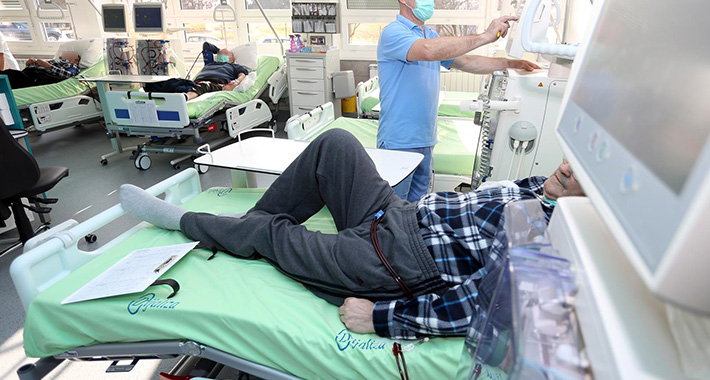
According to the research done by Fokus, the blockade of this tender has elements of a criminal offence and thus can lead to the criminal liability of a number of actors, since the last public procurements were realized in 2016, or to a lesser extent in 2017. And since then, among other bidders, companies representing Fresenius Medical Care BiH, including Melcom Ltd. from Mostar, have been selling the company's dialyzers at disproportionately high prices.
This has led to multimillion-dollar losses in the Federation, as the prices of dialyzers in the FBiH for some models of dialyzers are three times higher than, for example, in Serbia and Croatia. On the other hand, the company Melcom, which is the distributor for Fresenius Medical Care (FMC), has on several occasions since 2017 thwarted tenders with its complaints, which were accepted by the BiH Complaints Review Office. The last time that happened was on September 11, 2019, when everything on this issue was blocked.
We also investigated whether this blockade, which brings lucrative income to certain bidders on an annual level, also has a political background, that is, whether there are connections between bidders and persons who are the heads of federal institutions.
It should be emphasized here that health care at the federal level (whether it is the Ministry or federal institutes) is managed by the staff of the HDZ BiH, the party to which this department previously belonged in the distribution at the FBiH level. Furthermore, the founder and director of Melcom from Mostar, Mate Čujić, is a longtime friend of the current director of the University Clinical Hospital Mostar, Ante Kvesić, who is very close to Dragan Čović, the leader of HDZ BiH, and about which Žurnal wrote. But let's go in order.
The Contracting Authority – FBiH Institute of Health Insurance on December 27, 2016, for the last time, successfully implemented the procedure of procurement of dialyzers (dialysis consumables) for the needs of dialysis centres in the FBiH.
At the end of March 2017, the Office initiated a procedure for the procurement of a dialyzer, which annulled the Office for Reviewing Complaints, all because the Office, as a contracting authority, conceived the procurement in a confusing way. Namely, instead of defining the same products in dual lots, the Institute gives different specifications, that is, different sterilization methods, which automatically means two different products. This is in contradiction with the Rulebook on the conditions regarding space, staff and medical-technical equipment for the establishment and organization of work in health institutions that perform dialysis procedures.

Half a year later, the Office again initiated the procedure for the procurement of dialyzers with changes to the tender documentation, which the Complaints Review Office annulled on January 18, 2018, explaining that the tender was not in coherence with the Rulebook and restricts bidders in terms of economic and financial capacity.
Then, on December 20, 2017, the Office for Review of Complaints “due to a vaguely defined request regarding dual lots” sought the opinion of the Federal Ministry of Health. The question they ask is: “Is the correct decision, in regards to the Rulebook, to procure 2 dialyzers from different manufacturers with identical characteristics (including the sterilization method) within dual procurement lots or is the correct attitude to procure 2 dialyzers from different manufacturers within dual lots with the same characteristics but with different sterilization methods (steam sterilization and gamma radiation sterilization)? ”
The Federal Ministry of Health (then still headed by Minister Vjekoslav Mandic – HDZ, who died in the meantime), responds that the correct decision is to procure dialyzers from different manufacturers and different characteristics in relation to the type of sterilization, and the Institute on March 29, 2018, launches a new tender for the procurement of dialyzers, now with three changes to the tender documentation, while the opinion of the Ministry is an integral part of the tender.
However, after Melcom's appeal, the procedure is annulled again, on July 31, 2018. The Complaints Review Office is based on amendments to the Rulebook and adding “at least two different manufacturers” and vaguely defined requirements from the tender documentation regarding the application for dual lots, then the bidder individually and the bidder within the group as well as the use of the opinion of the FMZ, taking into account that it was given before the amendments to the Rulebook. At the end of October 2018, the Institute will re-initiate the procedure for the procurement of dialyzers, which will be annulled again on January 17, 2019. The complainant this time is 3AN Pharma d.o.o.

What is interesting is that this time the Institute, in terms of financial and economic capacity, asked the potential bidder that “the amount of total turnover in the period for which they submitted a statement, cannot be less than twice the estimated value of the lot, and if they offer a bid for several lots, the amount of total turnover may not be less than twice the amount of the collected estimated value of the lots it offers ”.
Thus, in practice, the tender is additionally “locked” for only selected wholesalers that have previously realized jobs in the field of dialysis, which is essentially announced only by the contracting authority, ie the Institute of Health Insurance for the FBiH. Due to this requirement, many large wholesalers supplying the market with medicines and medical devices cannot qualify for tender and offer dialyzers from many manufacturers registered with the BiH Medicines and Medical Devices Agency, which is discriminatory.
It is interesting that this approach is applied by the Institute only in the field of dialysis. Namely, at the beginning of this month, the Bureau informed the bidders that this year they will procure dialysis consumables – AV lines, physiological solutions, etc. after the appeal procedure was completed at the end of last year.
But let’s get back to dialyzers again. On March 29, 2019, the Institute will re-initiate the procedure for the procurement of dialyzers, which will be annulled on September 11, 2019, again because of the complaint of Melcom. This time the tender is annulled “due to non-compliance of the procurement in question with the material regulation (Rulebook) with instructions”. And in those instructions, the contracting authority has to discuss with the competent ministry the issue of procurement of dialyzers (a. Gamma and b. Water vapour sterilization) and, in accordance with the opinion of the Federal Ministry of Health, to publish the tender documentation procedure.
This is required even though the Federal Ministry of Health already has an opinion on how to prepare dual lots. But then the situation is further complicated by the unusual move of the Federal Ministry of Health, which withdraws its opinion in a letter dated December 3, 2020, which prevented any further tender for the supply of dialysis consumables – dialyzers.
It should be further emphasized here that since September 2019, after the decision of the Complaints Review Office, the Institute of Health Insurance has repeatedly asked the Federal Ministry of Health to issue the requested opinion in order to harmonize the tender with the material regulation, but without success. Despite the eight urgencies of the Institute, that did not happen!
On the occasion of the blocked tender for dialyzers, Fokus.ba addressed the Federal Ministry of Health and the FBiH Institute of Health Insurance on several occasions. But we did not get answers to our questions.
Melcom Ltd. Mostar replied that they are just one of the wholesalers with which Fresenius Medical Care Sarajevo has signed a contract for the distribution of consumables and dialysis equipment.
“There is no agreement or intention to prevent competition in favour of Fresenius Medical Care, given that representatives of all manufacturers of registered dialyzers with the Agency for Medicinal Products and Medical Devices of BiH participated in the specific public procurement procedure at the time of the public procurement procedure as which are: B. Brown, Nipro and Gambro. The mentioned public procurement procedure was divided into lots, more precisely into 13 of them, and Melcom was chosen as the most favourable bidder on only one lot. All decisions and decisions within the public procurement procedure are made by the authorized bodies of BiH on the basis of legally prescribed authorizations”, said Melcom.
Last year, Transparency International BiH also addressed the Federal Ministry of Health regarding the non-implementation of this tender and the entire procedure. The response of July 15, 2021, signed by the Federal Minister of Health Vjekoslav Mandic (died October 7, 2021), states that this ministry remains of the opinion that consumables must be procured from two different manufacturers and two different suppliers.
It is further stated that the Institute has a mandate to procure consumables for all dialysis centres in the Federation of BiH with which it has a contract, and that is, among others, Melcom, a company from Mostar that represents Fresenius Medical Care BiH and which, as we stated, since 2016 in the FBiH with the other two distributors on the basis of tender agreements from 2016 sells dialyzers at disproportionately high prices.
For example, Fresenius Medical Care in the Federation of BiH, when it comes to dialysis consumables, has an average price higher than in Serbia, by 6 to 15 KM more per product. According to the calculation, only 6 out of 9 lots of “water vapour” in the FBiH make an annual loss of about one million KM compared to prices that are valid in Serbia, for example.
At this point, it is necessary to shed light on the past of Fresenius Medical Care BiH, which is a subsidiary of Fresenius SE & Co. KgaA, a healthcare company based in Bad Homburg (Germany) that provides dialysis products and services in hospitals and inpatient and outpatient medical care.
In September 2010, the director of Fresenius Medical Care BiH, Želina Džafić, who is still the director of this company, signed an agreement with the then-mayor of Brčko District Dragan Pajić (SNSD) on the construction of a dialysis centre based on public-private partnership. The dialysis centre in Brčko was officially opened on August 24, 2011. Fresenius, in the mean time, opened a dozen dialysis centres in Republika Srpska.
In the years that followed, Fresenius SE & Co. The KgaA was shaken by a severe corruption scandal, so in 2019, this company reached an agreement with the United States Department of Justice due to allegations of corruption at the global level. She paid a draconian fine of $231 million to solve allegations of bribery to get a job in Angola, Saudi Arabia, Morocco, Spain, Mexico, Turkey and other countries. According to a publicly available report, there were bribes in BiH as well!
Namely, on page 13 of the Report, which was published on the official website of the US Department of Justice, includes corruption in Bosnia and Herzegovina, more precisely in the Brčko District.
“ In Bosnia, the FMC also made improper payments to a well-known doctor in power to support the FMC's bid to win a government tender to establish and operate clinics in Republika Srpska and Brčko. In November 2008, the doctor was elected to the Brčko Assembly. The report on activities in the fourth quarter of 2008 described the doctor's referral to the FMC as an achievement “eliminating all problems with the tender in Brčko”. The FMC initially did not investigate the significance of the entry and instead paid the doctor $80,850 in December 2008. In February 2009, the doctor was elected mayor of Brčko, after which a consulting contract was signed in the name of the doctor's wife. By 2009, the FMC had paid the doctor more than $1.3 million. The FMC also paid more than $957,000 for the clinic in Brčko and Herzegovina, without any evidence of rendered services. In total, FMC earned more than $10 million as a result of misconduct in Serbia and Bosnia”, the report said.

The mentioned mayor-doctor was SNSD member Dragan Pajić, and this case has not experienced a judicial epilogue in BiH until today. Želina Džafić is still the director of Fresenius in BiH.
Fresenius told Fokus.ba that their dialysis consumables on the Federation market are traded by several wholesalers with whom they have business cooperation, and who, they add, independently participate in public procurement procedures and determine the prices of dialysis supplies.
“ We believe that the competent bodies of BiH in the implementation of their powers in public procurement procedures respect the applicable legal regulations”, they pointed out.
As for the report of the US Department of Justice, as they stated, it refers to old cases “which are now fully investigated after Fresenius Medical Care reported itself to the competent US authorities in 2012.”
“ Since then, we have significantly strengthened our control mechanisms. As a result of this consistent action, investigations by the US authorities have already been completed under the Suspension Agreement concluded with the US Department of Justice in March 2019. We have also taken extensive steps to further strengthen our company-wide compliance and internal control programs. We will continue to do so in close cooperation with the authorities. Improving these programs is an ongoing effort to help us further improve the services we provide to our patients around the world and in Bosnia and Herzegovina, which is our primary mission. The case in Bosnia and Herzegovina refers to the accounting policies from 2008, which, to our knowledge, were not investigated by the local authorities”, Fresenius underlined.
Medin Okić, director of the Sarajevo company CEE-MED, which deals with the marketing of medical products and equipment, told Fokus.ba that this company did not appear in the Institute's tenders, due to the conditions created by this institute when creating tender documents.
“ For reasons known to them, they set these conditions very high, and above all they concern economic, financial, technical and professional abilities. They automatically disable potential bidders, including his company, who have registered medical devices with ALMBIH, who meet the technical specification, but due to high requirements regarding turnover and executed contracts are not able to participate in public procurement procedures conducted by the Health Insurance and Reinsurance Institute of FBiH, specifically for the procurement of dialysis consumables, which benefits certain bidders”, says Okić.
It is clear to him, he points out, that the Institute of Health Insurance wants to have security in regular deliveries and guarantees for the execution of contracts, but there are other mechanisms that can provide the same, and at the same time enable active fair competition as one of the basic principles on which the public procurement system is based.
“Regarding the procurement of consumables – dialyzers, on several occasions we, as holders of approvals at ALMBIH and interested in legal entities for specific public procurement of consumables – dialyzers, sent inquiries to the Institute of Health Insurance about the status of specific procurement, which always refer us to the Federal the Ministry of Health, which has not given an opinion on the bylaw for more than two years. It is nonsense that someone who is the issuer of a legal act does not know or will not submit his interpretation, that is, the opinion required of him by the Office for Review of Complaints of BiH and the Institute of Health Insurance as a contracting authority. Passive action of administrative bodies leads to the fact that consumables – dialyzers are procured by annexing the last successfully executed contract, because patients must not suffer, and really must not. However, passivity and waiting indefinitely, in our opinion, causes significant financial losses according to the Institute of Health Insurance”, says Okić. Focus